Building the Blueprint for Connection
Through a two-year action-learning initiative, the Social Vital Sign project implements social isolation screening and referral pathways directly into clinical settings. Using a "build while implementing" strategy, we launch active services immediately to bridge the gap between healthcare and community support, capturing real-time data to create a validated blueprint for national scaling.
Our 3 phase process:


How we connect

Assess the foundation
Conduct baseline assessments to define the eligible population, map current workflows, and establish the community partners list and capacity.

Launch in real time
Co-design and launch contextualized SIL screening protocols and referral pathways to community-based social prescribing services.

Adapt our workflows
Capture weekly and monthly learning, update protocols, and systematically document workflow adaptions.

Collaborate to share insights
Collect core metrics, submit de-identified data for cross-site synthesis, and participate in monthly cross-learning and quarterly synthesis sessions.

Track our impact
Document real-world implementation costs and resource requirements.
Assess the foundation
Conduct baseline assessments to define the eligible population, map current workflows, and establish the community partners list and capacity.
Launch in real time
Co-design and launch contextualized SIL screening protocols and referral pathways to community-based social prescribing services.
Adapt our workflows
Capture weekly and monthly learning, update protocols, and systematically document workflow adaptions.
Collaborate to share insights
Collect core metrics, submit de-identified data for cross-site synthesis, and participate in monthly cross-learning and quarterly synthesis sessions.
Track our impact
Document real-world implementation costs and resource requirements.
A model built on partnership
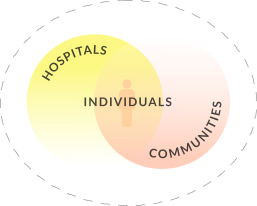
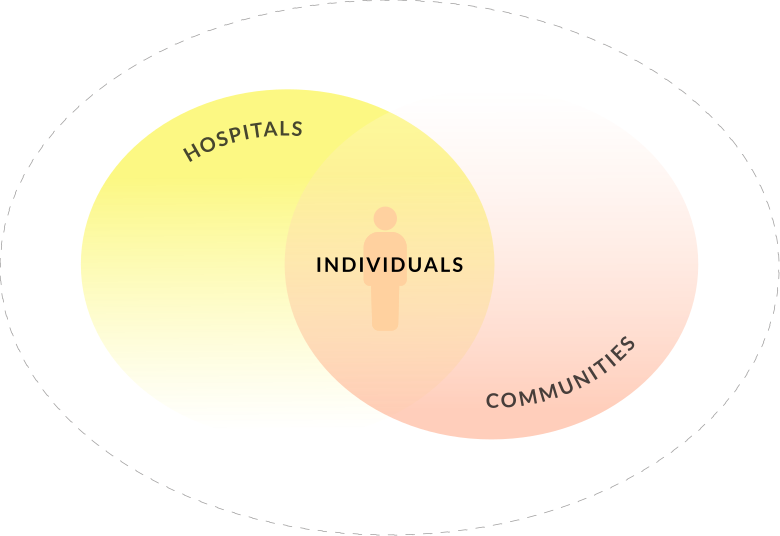
The Social Vital Sign project is built on the conviction that community organizations are not referral destinations. They are the infrastructure through which care actually reaches people. Three hospital settings work alongside a network of community partners to demonstrate what a genuinely connected system can look like. By spanning rehabilitation, geriatric, and acute care contexts, we show how screening and referral workflows can adapt across settings, and how hospitals can function as active connectors within a broader web of community support.
Hospitals as connectors, not owners
Hospitals are positioned as nodes within a broader social and health ecosystem, not as the architects or owners of the solution. Every partner's voice carries equal weight because the best solutions come from the people closest to the problem.
Starting from community strength
Solutions come from community assets. We map existing programs, organizations, and networks first, and build pathways toward them. This is not a model imposed on communities. It is a model built with them.
Built to adapt
The framework adapts to both small community hospitals and large urban centres. Contextual adaptation is built into the design, not added as an afterthought.
Hospital Partners
Bruyère Health
Bruyère Health is a Phase 1 implementation site focused on Rehabilitation, with expertise in geriatric rehabilitation, complex continuing care, and integrated community-based services. Their clinical leadership and rehabilitation expertise support the integration of social isolation screening and social prescribing into care pathways, helping refine practical and sustainable models for implementation.

Niagara Health
Niagara Health is a Phase 1 implementation site focused on Geriatrics and Emergency Medicine. Their strong foundation in social medicine and health equity supports the integration of social isolation and loneliness screening and social prescribing into acute care workflows.

St. Clare’s Mercy Hospital
St. Clare’s Mercy Hospital is a Phase 1 implementation site focused on General Internal Medicine. Their regional social prescribing networks and clinical expertise help shape practical, patient-centered screening and referral pathways in hospital settings.

Community Partners
Canadian Red Cross
The Canadian Red Cross brings national reach and deep experience in social supports for older adults, including friendly visitor programs and transportation services that form a critical part of the referral pathway.

Ontario Alzheimer's Society
With expertise in supporting older adults with complex social and cognitive needs, the Alzheimer's Society helps ensure screening and referral pathways are responsive to the full range of patients who encounter social isolation.
Canadian Institute for Social Prescribing
The Canadian Institute for Social Prescribing contributes national expertise in linking clinical settings to social supports, and supports the development of referral frameworks that are scalable across diverse care contexts.
The path forward
The project's final phase transitions from local implementation to national impact. By synthesizing real-world evidence from across our sites into a scalable blueprint, and documenting implementation costs, community partnership requirements, and readiness assessment tools, we are creating a validated framework that hospital systems across Canada can adopt.
The goal is a system where hospitals move from fragmented care to an integrated model that treats social isolation as a fundamental component of health, and where the community organizations that make that possible are recognized as the infrastructure they have always been.
Be a part of the movement
Want to learn more about our approach or ways to collaborate?
Fill out our form or contact info@socialvitalsign.com for more information.